Project Ecuador

Project Ecuador
Giving Hope and a Future

Monday, 18 April 2016

Earthquake Experiences

When Gabi, her husband and her family set off for a weekend at the beach, they had no idea what lay in store. Lesly, her 12 year old daughter, and Matias, her 4 year old son, were very excited about the trip, as they had never been away for more than a day trip before. The school holidays were drawing to a close, and they were keen to have a little holiday before classes started again.

They arrived at the beach on Saturday morning, found a hotel, and set off for the sea. They loved swimming and playing in the sand. As dusk approached, they headed to their hotel room to get showered. They were all naked when the earthquake hit. In an instant the roof collapsed on top of the four of them. Gabi managed to throw herself on top of her son, but she could not hear anything. She screamed for Matias or Lesly to answer her, but she could hear no reply. Finally she heard a whisper from her four year old, "Don´t scream Mummy, God is with us." Then she heard Lesly calling out that she was under a pile of blocks. She was so thankful to know they were both alive.

Gabi´s mother, sisters and cousins managed to get out of the hotel. They came to find their relatives and struggled to pull them out from the rubble by hand. Gabi was the last to be pulled out into the open. They were hysterical, but not seriously injured. They made their way up on to a hill, along with many other people, to wait out the night. They said it was pitch black and none of them slept. It was the longest night of their lives. Across the hill they could see a family setting up a makeshift wake for a relative.

They said they saw just one fireman in the town, trying to help the more seriously injured. Many were crying for help, and everyone was just searching for the members of their families. There were also thieves already looting, stealing from the abandoned stalls by the seafront.

At daybreak, they set off to try to find a way home. They tried many different roads away from the coast, only to find they were impassable. Everywhere they went, they saw houses fallen to the ground, and people sleeping outside under mosquito nets. Eventually, 20 hours later (a journey that usually takes 4 hours), they reached home. There were long queues in the petrol stations and they ate nothing all day. They arrived at 1am.

They are pale and bruised, but remarkably unscathed. So many others were not so fortunate. Aid is reaching the main towns, but not yet the smaller villages. Police and military are having to escort aid trucks, as thieves have attacked some en route.

Project Ecuador will buy food, water, repellent etc. to send to the victims with any donations we receive for the earthquake victims, and take them to the offical collection points.

http://uk.virginmoneygiving.com/charity-web/charity/finalCharityHomepage.action?charityId=1002812 

Please pray for those who are taking part in the rescue effort, and for those who have been left without loved ones and homes.


Saturday, 16 April 2016

Girls

The Girls´ Brigade started in 1893 in Dublin, Ireland. Since then, it has grown to have groups in over 60 countries of the world. The aim of the Girls´ Brigade is to "help girls become followers of the Lord Jesus Christ and through self-control, reverence and a sense of responsiblity find true enrichment of life."

I am running a club for girls with the same aim here in rural Ecuador. Most of the 50 girls who come go to a church, be it the Catholic, or an evangelical congregation. The club gives them the chance to learn from the Bible together, to discuss their beliefs and ask their questions. One of the common errors in their thinking is that they believe they can earn their way to heaven through good works. We try to help them understand that salvation is the free gift of God, through Jesus.

The girls love playing games, working in teams and making crafts together. The club gives them the space to form new friendships and deepen existing ones. Often it is these friendships which lead to the opportunity to offer counsel and advice in their daily problems.

In a community where teenage pregnancy is rife, where girls are often not respected, and poverty abounds, it is wonderful to have the opportunity to speak frankly with the girls about self control, self respect and responsibility in the context of sexuality. Alongside giving practical support in the form of sponsorship so that they can attend school, the girls also need much guidance, encouragement and building up as they make decisions.

They also learn responsibility through activities such as the business badge the teenagers have just completed. I gave each small group $10, and they had the challenge of cooking and selling to make a profit. All the groups returned me my investment and made a profit. We celebrated by using the money for a trip to the cinema (something most of them had never done before). More importantly, the girls have realised they can take responsibility for their own lives. They can do something about their poverty. Many are continuing to make and sell things for themselves, alongside their ambitions to study and make something of themselves.

Only time will tell what the future holds for these girls. I personally owe a great debt to those who taught me as a girl in the Girls´ Brigade. Their example and encouragement played a large part in forming my faith and self confidence. I hope the new generation will similarly benefit from this and other similar initiatives.

Tuesday, 15 March 2016

Learning to wear glasses

Whenever I check the vision of children around here for the first time, I am always amazed that there are children with very poor sight, now aged 11 or 12, who do not have glasses. Some of these children do not even realise that they could see better. Others have noticed, but no one has taken them for a vision check or tried to help them. A few have been given glasses, but do not wear them.

The lack of sight has a profound effect on their studies. Often, they are not sitting near the front of the class, even though they cannot see what is written on the board. Those with short sight develop lazy eyes, or squints, with their vision worsening over time. One girl I met had been taken for glasses, but refused to wear them, because she was the only person in a school of 100 pupils with glasses, and the others laughed at her and called her "granny". Her vision had become so bad her eyes were permanently half closed, and the lashes were touching her eyeballs. She now needed surgery to be able to rescue the situation.

Those who have "lazy eyes" can have their vision corrected through the use of glasses and patching. Their vision can improve greatly. But they need the help before the age of 12. The mother of one of the children I gave glasses to this month never had glasses herself. One of her eyes is now permanently deviated and almost completely blind.

The first time I gave glasses to the children in the Garcia Moreno school there were 2 girls with lazy eyes. A couple of months later the teacher told me I shouldn´t waste my money on those children as they did not like to wear the spectacles. The real problem was that these children feel ridiculed when they wear them. They, their parents and their teacher did not understand the long-term consequences of not wearing them. Their reluctance to accept help was not a call to give up, but rather to provide more education and support.

Therefore, this time, when I recently gave glasses to 13 of the mostly older sponsored children for the first time, I did so along with some fun and games. I gave them out at the club meeting. All those receiving glasses had to out them on in front of the others. The girls with good sight tried them on and saw what it is like to have blurred vision. We played some blindfold games together. All the girls made some card glasses and I took photos of each of the girls wearing their glasses, be they real or fun.

I then printed the photographs and each girl had to decorate the frame with positive words about themselves, to improve their self-esteem. I also sent home reward charts for the mums to sign each day that the child wears the glasses, with the promise of a reward if they wear them for a month. Hopefully by then they will be so used to wearing them, the embarrassment will have worn off.

Certainly so far it seems to be working. The children in the primary schools now have their glasses on whenever I visit. The sponsored children have them on when I bump into them in the village, and one who was very reluctant to wear them, apart from when actually studying,  has now changed her Facebook profile picture to one where she is wearing her specs - and very good she looks too!

Monday, 22 February 2016

An insight into changing aspirations ...

One of the sponsored children came to give me her school report this week. She was about to accompany her mother, who is already in her sixties, to Colombia for medical treatment. We had an interesting conversation, which illustrates some of the ways people think around here.

Franci is seventeen, and about to start her final year of secondary school.

Me: How many brothers and sisters do you have?
Franci: I have 6 sisters and three brothers. The oldest is forty years old. My mother was 46 when she had me. I am the youngest.
Me: And how many nieces and nephews do you have?
Franci: Too many to count! There must be more than 20 of them. One of my sister´s just had a new baby boy. He is very cute with big wide eyes and beautiful curly hair. I¨m also a great-aunt.
Me: What do you hope to do when you finish school?
Franci: I hope to study nursing at University. I will need to work during the day and study in the evenings to be able to do that. My family tells me it is impossible. None of them have gone to University, but I would really love to be a professional.
Me: What age do you think you would like to be married?
Franci: Oh, maybe about 30. I want to complete my studies first, otherwise I won´t be able to. My sisters have all had children very young, and they are all trapped. It´s OK if your husband turns out to be kind, but most men are very controlling. They don´t let them out of the house. If they are mistreated they cannot run away because they have no means of making a living and providing for their children. I want to be able to have my own career and income.
I haven´t had a boyfriend yet. My sisters tell me not to until I have finished studying, because once you have a boyfriend babies come along! But some girls at school ask me if I am gay because I haven´t had a boyfriend yet. (Franci laughs). I just want to wait.
I do want to have a husband. I hope he will be very romantic and understanding. And I do want to have children, but just two or three. I want to be able to provide for them well and give them a good education.
I was talking to a woman the other day who has four children and wants to have a fifth. But I asked her why she was going to have another when she cannot even feed the ones she has. She doesn´t see the importance of educating her children. 
Me: What are you doing during your school holidays?
Franci: I have been doing a course at the evangelical church because I want to be baptised. Now I´m going to accompany my mother to Colombia because my sister lives there and can help her get free health care.
Me: I look forward to seeing you again when classes are about to begin again.


Monday, 8 February 2016

Recycling

Ecuador does not have cheap clothes and toys such as are available in shops like Primark and Tesco in Britain. Clothes are relatively expensive and making your own is still cheaper than anything you can buy ready made. Cheap toys are terrible quality - they would not pass safety standard test in the UK and often break in the first day or two. Toys of any quality cost money. Therefore I should not have been surprised that when I threw out my underwear as now too worn out for me to wear, I later saw it hanging on my neighbour´s washing line. Here people really do use things, mend things, and use them again, until they are completely destroyed.

Recycling is a way of making money. I walk past a large school on my way to check the PO box at the post office each week. Outside, they leave large sacks full of rubbish. Often, there is a little old woman sifting through the bags, hunting for anything that could be recycled that she can put in her cart. She takes these items to the recycling yard, they buy the items from her, and this is how she earns her living. 


Woman with recycling she has collected on her back at the recycling yard 
When I visit homes in Ecuador they are not full of clutter. People simply do not have many things. It certainly makes me stop and think before I purchase more and more. It makes me mend and reuse and recycle. It causes me to give things I no longer need to others who can use them, instead of throwing them in the bin. 
It makes me so thankful that I do not have to rummage through rubbish to make ends meet. It challenges me to hold on to less and be more generous with what I have.After all, "The earth is the Lord´s and everything in it, the world and all who live in it." Psalm 24 v 1. I should be sharing all that God has gracious given me with others.

Thursday, 7 January 2016

Christmas Gifts


I have been silent for the last month because I was so busy giving out Christmas gifts.  First we held an event for the sponsored children. The children gathered, very excited, at the village hall, joined in the games with gusto listened attentively to the talk I had prepared, and then happily each received their bag of gifts.  Refreshments finished our time together.  


The next day, I held the nativity play for the Girls´ Brigade girls. They loved dressing up and performing for their parents. They also each received a gift and a bag of sweets. 


The following two days I visited six local schools giving out more gifts to the primary school children.  It was great fun to see their eyes light up as they received their gifts and tried them on or read them.   


The children valued their gifts because they receive very little at Christmas – or at any other time of the year. Some of their gifts, and the cakes and treats were made by the local sewing group. These women value the work I am able to put their way in this manner, and also the chance to learn new sewing and baking skills. 
 
My talk this year was about the gifts the wise men took to Jesus.  Hardly any of the children could tell me what the gifts were – let alone what they meant.  I explained the gold was in recognition that Jesus is king, frankincense in recognition of his divinity and that myrrh anticipated his death which brought us salvation. 


We then had a beautiful family Christmas, celebrating with our extended family and close friends.  We ate our ham, accompanied by rice, outside in the heat on Christmas Eve night, with the singing of carols in Spanish and readings from the Christmas story. Of course, there were gifts exchanged amongst us too, especially for the children. 

The festive season was tainted with sadness too, as is the way in this damaged world of ours.  I found myself writing the death certificate for an elderly neighbour and hearing of the tragic death of the son of one of the teachers in our most local school.  He died in a motorbike accident.

Often we ask, “What was your best present this year?” As I reflect on the gifts given and received this Christmas and indeed at other times of the year, I conclude the best gift of all is one I usually take for granted; the gift of another day of life.  

As we enter the New Year, may I remember to give thanks for that simple and yet most precious gift of God each and every day. 

Thursday, 3 December 2015

The patter of little feet.


Expecting a baby is an exciting time.  It is a time for buying cute little outfits, knitting tiny booties and decorating a nursery.  It is a time for acquiring a cot, a pram and sling, toys and books and puzzles. 
I received donations of baby clothes recently, and went to deliver a parcel of baby-grows and vests to a pregnant neighbour today.  She is now seven months along and is so excited about her baby. 
“I already have two boys,” she confided, “and it would be so wonderful to have a little girl this time.  But whichever it is, he or she will be so precious.  Children are such a blessing aren´t they?” 
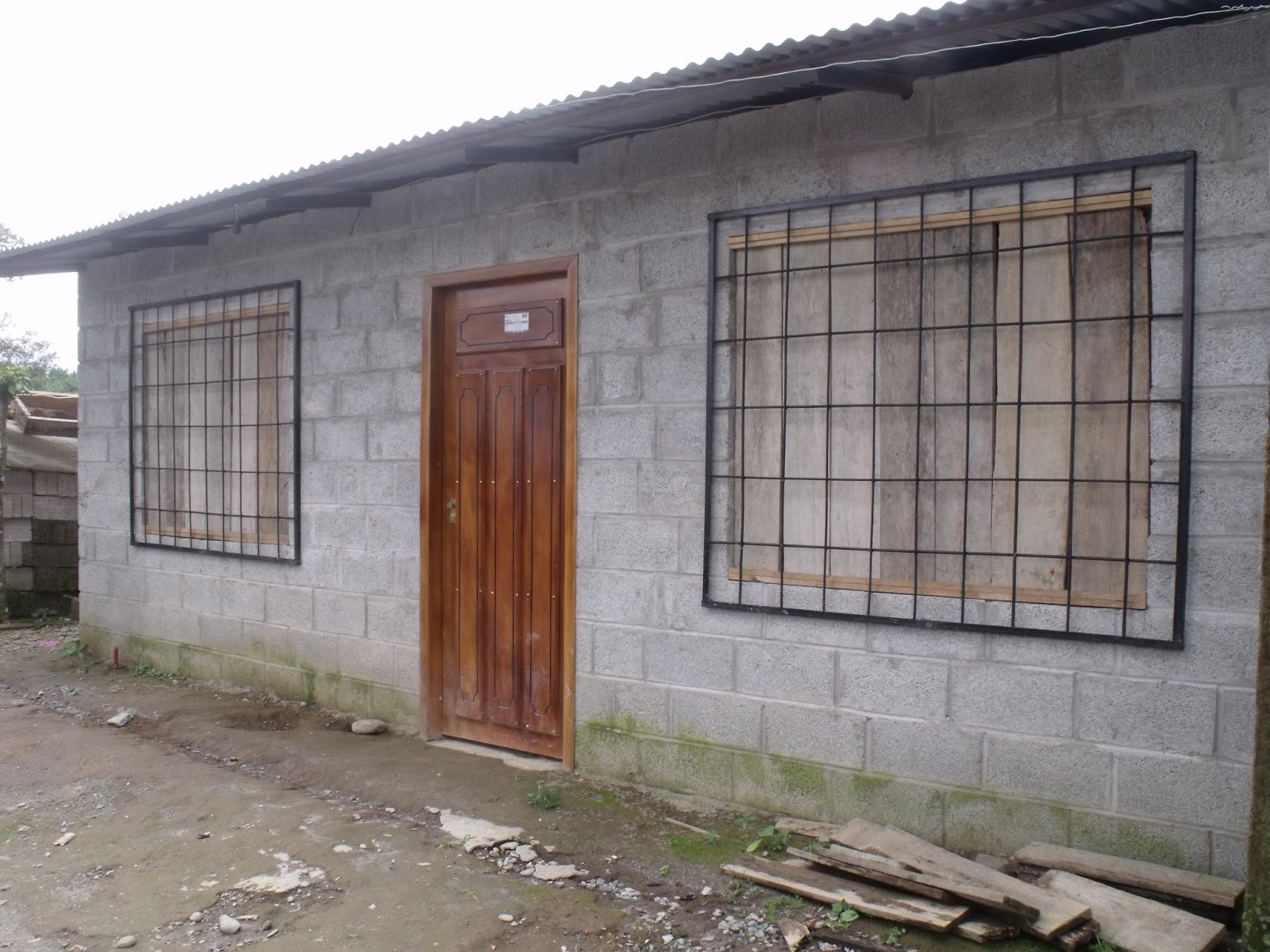
She fingered the soft baby clothes tenderly, as the scent of fabric conditioner filled the room.  I looked around the new, block house curiously.  Obidio and Lidia had only recently managed to build this house of their own, on land given to them by Obidio´s parents.  I am used to being invited in to sit on a plastic chair in houses that do not contain a sofa, and to seeing chickens running through the house.  The lack of doors on the bedrooms allowed me to notice there was absolutely no evidence of baby equipment in the house whatsoever.  I think the clothes I took were the first items that baby received.  What shocked me was that there were no front or back door to secure the house, nor window protections. 
“We managed to build the house, but won´t have the money to make doors for a while yet,” Lidia explained.  “We just put up some boards and hope that no one breaks in in the night.  I had a fright the other night when a cat came in.  I thought it was burglars.” 
I cannot imagine bringing a baby into this world while lacking such basic security in my home.  It is not only the threat of thieves, but also the house being wide open to mosquitoes and the elements
 I felt so vulnerable when I had new-borns.  I also felt an over-powering desire to protect my youngsters.  Lidia is no different.  Her parting comment to me was that she was worried about leaving her two boys while she goes to the hospital to give birth, because they are never usually without her. 
I think this will be the next family to receive a helping hand from the housing fund.  

A house with a front door and window protections